
Digital Marketing in Lafayette, LA: What Actually Works in 2026
Search "digital marketing Lafayette LA" and you get a page of agencies saying roughly the same thing: full service, data driven, results focused. What that phrase does not tell you is whether any of it will produce a phone call from somebody in Broussard who needs your service this week. So this is the version with the packaging stripped off. What digital marketing actually is for a business in Acadiana, which parts produce revenue and which parts just look busy, what it honestly costs here, and how to tell a real partner from a rented logo.
What digital marketing means for a Lafayette business
Digital marketing is every place a customer can find, judge, or contact you online, worked as one system instead of six hobbies. For a local business that comes down to five working parts:
- Local search. Your Google Business Profile, the map pack, and the searches people type when they already want what you sell.
- Your website. The only asset you own outright, and the place every other channel sends people to decide.
- Content and SEO. Pages and articles written to answer the questions your customers type before they know your name.
- Paid advertising. Google and Meta campaigns that buy attention now while the organic work compounds.
- Social and email. The channels that keep you familiar between purchases so you are remembered at the moment of need.
None of those five is exotic. The difference between a Lafayette business that gets found and one that does not is almost never which channels it picked. It is whether the channels point at the same customer, with the same message, measured the same way.
The real competition is the map pack and the AI answer
A buyer in Lafayette, Scott, or Youngsville does not browse anymore. They search, they look at three map results, they look at the answer sitting above those results, and they call one of them. That is the entire contest. Everything else in digital marketing is either feeding that moment or wasted.
Two shifts changed the shape of that moment in the last two years. First, the map pack got harder to crack because Google now weighs review velocity, photo activity, service coverage, and how consistently your name, address, and phone number appear across the web. Second, the answer above the results is increasingly written by AI, pulling from sources it trusts rather than from whoever bought the most ads. Being cited in an AI Overview or a ChatGPT answer is a publishing problem, not an ad problem. Businesses that get mentioned are the ones with real content on real local sites that describe what they do, where they do it, and who they do it for.
The six things that actually move revenue
1. A Google Business Profile run like an asset
For most local service businesses this single free listing produces more calls than any other channel. Categories chosen correctly. Service areas that match where you actually drive. Hours that are right on a holiday. Photos added monthly, not once at setup. Reviews answered within a day, including the bad ones. If you do nothing else this quarter, do this, because it is the cheapest revenue available to you.
2. A website built to convert, not to decorate
A pretty site that takes four seconds to load on a phone in a parking lot is a broken site. What matters: it loads fast, the phone number is one tap away, the first screen says what you do and where, service pages exist for the services you want sold, and there is a visible path to a call or a form on every scroll. Design should make those things feel natural, not replace them.
3. Content aimed at how Acadiana actually searches
People here search in plain language with a city attached: "ac repair Lafayette," "septic pumping Carencro," "med spa Youngsville." A page per service, in the language your customers use, with the towns you serve named honestly, does more than a hundred clever social posts. Where the content gets thin is at the buying stage, when somebody wants to know what a job costs, how long it takes, and what to ask before hiring. Answer those questions in public and you stop competing on price alone.
4. Paid search and social with honest measurement
Ads are the fastest lever and the easiest to waste. Google Search captures people already looking. Meta builds demand and retargets the people who visited and left. Both need three things to work: a tight geographic radius, a landing page built for the one offer in the ad, and a tracking setup that records calls and form fills as conversions. If nobody can tell you what a lead cost last month, the campaign is not being managed, it is being funded.
5. Reviews and reputation
Reviews are the deciding factor in the map pack and the first thing a customer checks before calling. The mechanic is simple and most businesses still skip it: ask every satisfied customer at the moment the work is done, make it one tap, and reply to every review you receive. Volume and recency matter more than a perfect average.
6. One thread across social, email, and local media
Social keeps you recognizable, email keeps you in the inbox of people who already bought, and local media puts your name in front of people who have not. Run them as one weekly rhythm from one content plan and the work compounds. Run them as three separate projects and you pay three times to say the same thing badly.
Why the AI answer changed the math in 2026
When someone asks ChatGPT or Gemini for "the best digital marketing agency in Lafayette," the model answers from what it has read: local publications, business directories, review sites, structured data, and pages that describe services in specific, checkable language. It does not answer from ad spend. If your business only exists on its own website and its own social profiles, you are mostly invisible to that layer of search.
That is why being published somewhere other than your own domain matters now. A business that appears in a regional publication, a local directory, and a well-built site gives the models three independent sources that agree on what it does and where it does it. That agreement is what earns the mention. It is also why 337 Media's approach leans on owned local media, not because publishing is fashionable, but because a citation from a publication that actually covers Acadiana carries weight that a directory listing alone does not.
What digital marketing costs in Lafayette, LA
Honest ballparks for the Acadiana market, the same numbers we would give you on a call:
- Website: roughly $3,000 to $10,000 for a professionally built small-business site, depending on page count, photography, and whether copy is written for you.
- Ongoing SEO and content: generally $1,000 to $2,500 per month. Below that, something is being skipped, usually research and reporting.
- Paid advertising: a management fee of roughly $500 to $2,000 per month, on top of whatever you spend with Google or Meta.
- Local listings and directory work: often included in a retainer, worth asking about by name.
If a quote lands far outside those ranges in either direction, ask more questions rather than fewer. Very cheap full service usually means strategy and reporting are missing. Very expensive does not automatically mean better, especially if nobody can explain what happens in month three.
A 90-day sequence that compounds
Digital marketing fails when it is treated as a list done all at once. The order matters more than the effort.
- Weeks 1 to 2, foundation. Fix tracking so calls and forms are recorded. Claim and correct the Google Business Profile. Audit the site for load speed and obvious conversion gaps. Confirm the name, address, and phone number match everywhere they appear.
- Weeks 3 to 6, build. Ship the site fixes. Publish or rewrite the service pages that matter. Start the review ask on every completed job. Launch a small, tightly targeted ad campaign for the single most profitable service.
- Weeks 7 to 12, compound. Publish content against the questions customers actually ask. Increase ad spend only where cost per lead justifies it. Add the directory and local media placements that make you citable. Report on leads and cost per lead, not impressions.
Ninety days of that sequence will not beat a competitor who has been consistent for three years, and anybody promising otherwise is selling. What it will do is give you the data to know what is working, which is what makes month four through twelve efficient.
DIY, freelancer, or agency
All three can work. The question is what you are actually buying.
Do it yourself makes sense if you have time, patience, and a tolerance for learning in public. The risk is inconsistency, which search engines read as neglect.
A freelancer is a good fit for a single channel done well, like a website or a Meta campaign. The risk is the gaps between channels, and the day they take a full-time job.
An agency costs more and should buy you a system: strategy, execution across channels, reporting, and someone accountable when something breaks. The risk is paying for layers and never meeting the person doing the work.
How to measure it without lying to yourself
Track four numbers and ignore the rest for the first two quarters: calls from search and maps, form submissions, booked jobs from those leads, and cost per lead by channel. Impressions and followers are context, not results. A business with 4,000 followers and four inbound calls a month has a marketing problem no amount of content will fix.
What working with 337 Media looks like
337 Media is a Lafayette-based marketing agency. We build websites that load fast and convert, run local SEO that targets the map pack and the organic results, manage Google and Meta campaigns against measured leads, and write the content that makes a business citable in both regular search and AI answers. Clients keep ownership of their domain, their ad accounts, and their listings, which means switching providers later is a decision, not a hostage negotiation.
We also own local media. 337 Magazine publishes daily across Acadiana, 337 Local runs a business directory for the region, and both exist alongside the agency work. That is not a gimmick, it is a structural advantage: when a client's story belongs in front of Acadiana readers, we can place it in publications we actually run, and the citation counts because readers are real.
Serving the whole 337, not just the Hub City
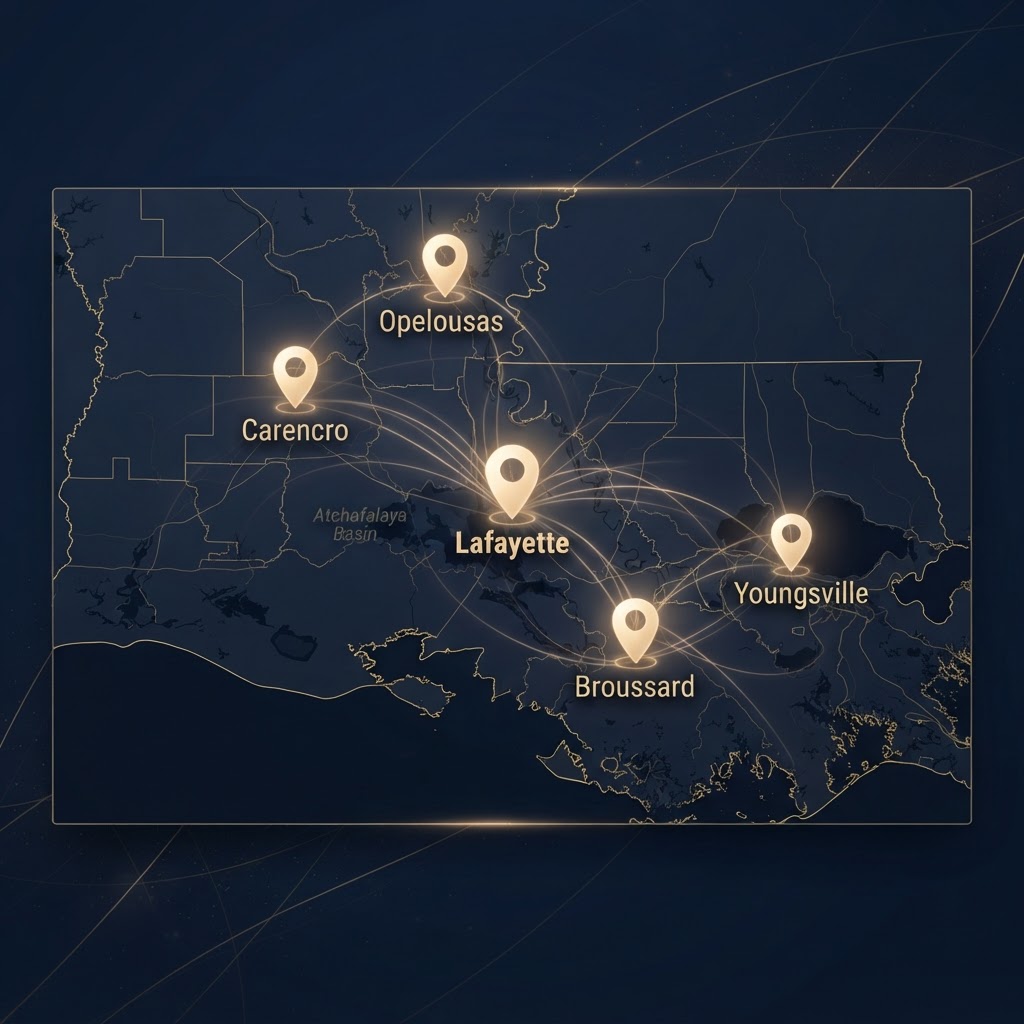
Lafayette is the center of the market, but the businesses we work with are in Broussard, Youngsville, Scott, Carencro, Duson, Breaux Bridge, Opelousas, and the smaller communities between them. Search behavior differs by town, and so does the competition. A dental practice in Youngsville is not fighting the same map pack as one on Kaliste Saloom, and the content that wins one will not automatically win the other.
Frequently asked questions
How long before digital marketing produces leads? Paid advertising can produce calls in the first two weeks if the tracking and landing page are right. Local SEO and content typically show movement in three to six months and compound after that. Any timeline shorter than that for organic results is guesswork.
Do I need a new website to do SEO? Not always. If the site loads quickly, has clean structure, and can publish service pages, it can be optimized. Rebuild when the platform fights you on speed, structure, or edits, because those costs add up every month you keep it.
What is the difference between SEO and local SEO? SEO targets searches nationally or by topic. Local SEO targets the map pack, the Google Business Profile, reviews, and city-level intent, which is where most Acadiana buying decisions happen.
If you want to know where your business actually stands, ask for a visibility review. We will look at your site, your listings, your reviews, and the searches you should be winning, and tell you plainly what is broken and what it would take. No guaranteed rankings, no theater, just the list.
Explore next: our marketing services, website design and development, the small business digital marketing strategy playbook, digital omnipresence and AI Overviews for Lafayette businesses, and SEO consulting and management for Louisiana businesses.
Local proof: read 337 Magazine for daily Acadiana coverage, and find local businesses in the 337 Local directory. Call 337-257-9011 or start a conversation.
Frequently Asked Questions
How long before digital marketing produces leads for a Lafayette business?
Paid advertising can produce calls within the first two weeks if tracking and the landing page are right. Local SEO and content typically show movement in three to six months and compound after that. Any shorter timeline for organic results is guesswork.
Do I need a new website to do SEO?
Not always. If the site loads quickly, has clean structure, and can publish service pages, it can be optimized. Rebuild when the platform fights you on speed, structure, or edits, because those costs repeat every month.
What is the difference between SEO and local SEO?
SEO targets searches nationally or by topic. Local SEO targets the map pack, the Google Business Profile, reviews, and city-level intent, which is where most Acadiana buying decisions happen.